
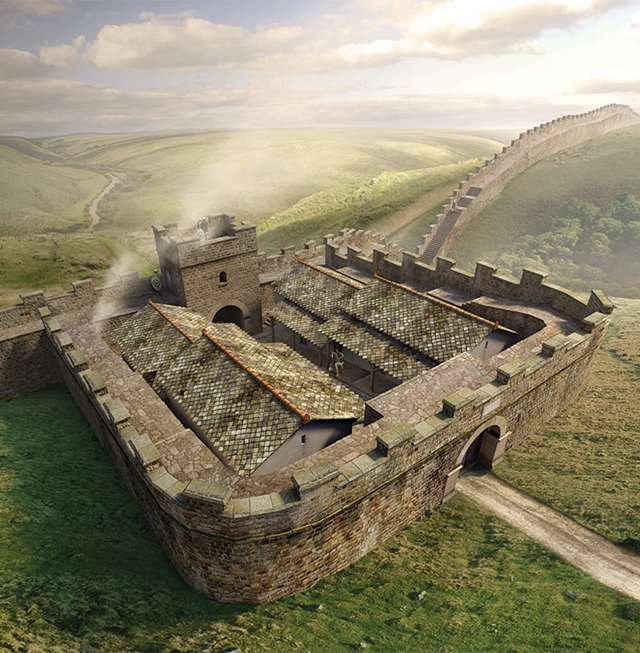
Hadrian's Wall was built by the Roman Emperor Hadrian in the year 122 AD. It ran for 73 miles across the width of England, from coast to coast. The wall was built to protect the northern border of the Roman Empire from barbarian invasions. Today, Hadrian's Wall is a World Heritage Site and one of the most popular tourist attractions in the UK.
Who was Hadrian?
Hadrian was born in Rome in 76 AD. His father was the Roman Senator Publius Aelius Hadrianus Marullinus. His mother was Domitia Paulina, from a non-patrician family. He had a sister, Paula, and a brother, Publius. In 85 AD his father died and he became ward of his maternal uncle Trajan.
He married Vibia Sabina, daughter of Titus Flavius Sabinus, in 100 AD. They had a happy marriage but no children were born to them. In 117 AD, after the death of Emperor Trajan, he succeeded to the throne and became Emperor Hadrian.
During his reign he travelled extensively throughout the empire - more than any other Roman Emperor. He built many public works including baths, temples, libraries and Canopus and Pharos Lighthouses in Alexandria. In 122 AD he started work on Hadrian's Wall which stretched across England from coast to coast.
What was Hadrian's wall?
When the Romans invaded Britain in 43 AD, they brought with them their advanced engineering skills. One of the most impressive feats of Roman engineering is Hadrian's Wall, a massive stone wall that stretched across northern England.
The wall was built in 122 AD under the orders of Emperor Hadrian. Its purpose was to protect the northern border of the Roman Empire from barbarian invasions. At its peak, the wall was over 80 miles long and 15 feet high. It had forts, towers, and gates spaced along its length, and a wide ditch on the north side.
Over time, the political situation changed and the need for such a fortification diminished. The wall fell into disrepair and was eventually abandoned altogether. Today, Hadrian's Wall is a popular tourist destination and a UNESCO World Heritage Site.
Why was the wall built?
The Roman Emperor Hadrian had many reasons for ordering the construction of a great wall across the north of England. The most important reason was to protect the empire from the Picts, who were a fierce group of people living in what is now Scotland. The Picts were always attacking Hadrian's Wall, so the Romans built it to keep them out.
Other reasons for building the wall include:
1) To keep out other barbarian tribes who might want to invade Rome
2) To act as a customs barrier between England and Scotland
3) To provide employment for soldiers who were not needed on the frontiers
4) To show how powerful Rome was
How did the wall fall?
In the early morning of 5th January, 410AD, the citizens of Rome woke to find the city had been sacked. The Visigoths, led by their king Alaric, had broken through the defences and looted, burned and murdered their way through the streets. It was a shocking event that changed the course of history.
The Roman Empire was in trouble long before the fall of Rome. In 395AD the emperor Theodosius died, leaving his empire divided between his two sons. The western half, ruled from Rome, became increasingly weak as it was attacked by barbarian tribes. The eastern half, based in Constantinople, grew in strength.
In 410AD the Visigoths (a Germanic tribe) were attacking cities in Gaul (modern day France). The emperor at this time was Honorius who ruling from Ravenna in Italy. He asked for help from Britain but none came.
On 24th August 410AD Alaric and his Visigoths arrived outside Rome. For three days they demanded money and supplies but Honorius refused to give in. On 27th August they broke through the city walls and began a rampage of looting and destruction that lasted for days.
It was a humiliating defeat for Rome which had never before been sacked by an enemy. Many Romans blamed their emperor for not doing more to protect them. It was also a turning point in history as it showed that Rome was no longer invincible.
What is the wall's legacy?
Most people know Hadrian's Wall as the remains of a great Roman fortification, built to protect the northernmost border of the empire. But the wall's legacy is much more than that. For centuries, it has been a symbol of Britain's strength and resilience.
The wall was built by the Roman Emperor Hadrian in AD 122. At 73 miles long, it was the largest structure ever built by the Romans. It took six years to build and was manned by a garrison of around 10,000 soldiers.
Despite its size and military purpose, Hadrian's Wall was not intended to be a barrier between peoples. On the contrary, it was a bridge - a way of bringing Roman civilization to the 'barbarians' beyond. Along with roads and forts, the wall was part of an infrastructure that connected Britannia to Rome.
For centuries after the Roman Empire fell, Hadrian's Wall continued to play an important role in British history. It was a boundary between England and Scotland and later became a pilgrimage route for Christians visiting St Cuthbert's shrine at Lindisfarne. Today, Hadrian's Wall is one of Britain's most popular tourist attractions, visited by over two million people every year.
So while Hadrian's Wall may have been built as a military fortification, its legacy is one of peace and cooperation.